The always nagging “trache” question

It is no surprise to my friends here that I absolutely HATE the fact that Hannah had to be trached after this past hospitalization.  We had been able to avoid a trach since she was 8 months old and then she had to be trached, NOT because of her Gaucher’s disease, but because she could not be extubated because she was oversedated.

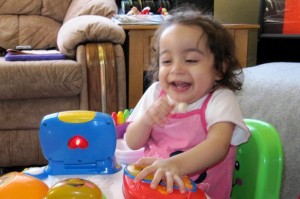
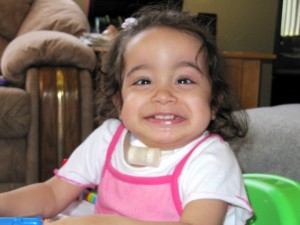
Hannah is not a fan either.  She pulls at the HME (the plastic covering on the trach) at least 100 times a day, most of the time taking it off and tossing it aside.  Other times, she tries to pull out her trach from under the collar.  Twice she has pulled it out halfway, and fortunately, I was able to get it back in without any issue.

Last night, we were watching TV.  Daddy looked down at Hannah resting on the floor, and he noticed that her trach was completely out.  She had taken the entire thing out!   After a few minutes, we were not able to get her 3.5 Shiley in, so we grabbed the 3.0 Shiley (smaller).  We were able to get that one in without any problems.  Then, we were able to put back the 3.5 Shiley.

The entire time Hannah was “decannulated” (without a trach), she was completely fine!   No breathing distress whatsoever, even though the stoma (hole) was covered while we were trying to get her trach back in.  She was breathing through her nose and mouth.  Honestly, we looked at her for about 30 seconds while the trach was out, and she was still playing with her toys in her hand, lying on her back, not realizing anything was different.

She was able to breathe normally without the trach.  What is especially notable was that after those first couple of minutes, the stoma was completely covered by excess tissue (which is why it was hard to get it back in at first).  It was awesome to see her breathing without any distress.

In the next two weeks we meet with her pulmonologist and her new ENT.  Her pulmonologist seems to be a very conservative guy, as we get the feeling that he feels that we should keep the trach in because she MAY need it in the future because of her Gaucher’s Disease.

I’m not a fan of that philosophy.  Hannah’s two favorite activities are limited by her trach — swimming and bath time.  If I could give her back those two activities that she loves, even if it is just for 6 months to a year (in case she needs the trach in the future), then I want to give it to her.  It would be one thing if Hannah’s condition was not as life-limiting — then we could take our time on the trach issue.  But unfortunately, it is life-limiting.  And while she is able to breathe freely on her own, without any airway issues like laryngospasms, etc, then I want her to have the time for as long as she can.

Obviously, I will in no way put her life in jeopardy to get this trach out.  If it turns out that she truly does need it now, then so be it.   But if we do have to keep it, I want it to be because she needs it not because she MAY need it at some point.

Hannah is in Time Magazine!

Is It Time We Paid More Attention to Rare Diseases
http://www.time.com/time/health/article/0,8599,2012177,00.html
By FRANCES PERRAUDIN


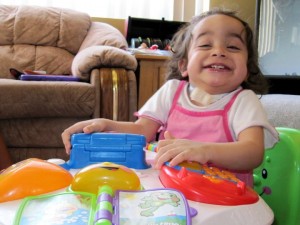
When Hannah Ostrea was five months old, she was diagnosed with Gaucher’s disease, a genetic condition in which the body lacks the enzyme needed to break down a fatty waste product called glucocerebroside, leaving it toaccumulate in the body’s organs. The disease is painful, with the excess glucocerebroside impairing mobility and delaying growth. Hannah’s form of the disease, Neuronopathic Gaucher’s disease, also causes brain damage and eye movement disorders and makes swallowing difficult. Neuronopathic Gaucher’s affects less than 1 in 100,000 live births and the life expectancy of a sufferer is between two and 20 years — Hannah is now two. But because the medical community won’t dedicate time or money to an illness that affects so few, there is no cure on the horizon. “Unless you have a celebrity who has a personal interest in your disease or you have a ‘popular’ rare disease … there are no big foundations, large fundraisers, or even any interest in assistance,” says Hannah’s mother Carrie. “It’s so hard knowing that there is so little research out there for my daughter, and that because of this, we will likely lose her sooner rather than later.”
Everybody has heard of the world’s biggest killers: cancer, HIV, malaria. But what about Xeroderma pigmentosum, which causes sufferers to react violently to direct exposure to sunlight? Or Jeune Syndrome, a potentially fatal bone-growth disorder that restricts the expansion of organs. An estimated 250 million people worldwide suffer from rare diseases — the term for about 6,500 disorders, each of which, according to the official U.S. definition, affects fewer than 200,000 Americans. Around 8% of people will become afflicted with a rare disease at some point in their lives. Treating these diseases puts a burden on health services and living with them can destroy families — losing a loved one is a tragedy, no matter if it’s to cancer or Kawasaki disease, which causes the inflammation of the blood vessels. But because of the rarity of each condition, the number of patients in any one country is too small for experts to use for effective clinical research or raise significant awareness.(See how to prevent illness at any age.)

There have been efforts to address this problem before. The Orphan Drug Act passed in the U.S. in 1983, for example, gives tax incentives to companies that choose to develop such drugs, and grants them the right to sell the drugs without competition for seven years. But this is hardly a comprehensive fix. In the hopes of finally giving rare diseases the attention they deserve, Dr. Christopher Forrest of the University of Pennsylvania and colleagues from the Office of Rare Diseases Research at the National Institutes of Health recently put out a call for the establishment of a global rare-diseases registry. The idea would be to allow patients, clinicians and researchers who are scattered around the world to enter their own data on new therapies and practices, all in one place. The registry would also provide more accurate patient-population statistics, so that instead of trying to study a handful of sufferers in one country, scientists and drugs companies would have access to information from thousands of people affected by the same rare disorder, making it much easier to conduct research into their causes and cures. “Disease knows no boundaries,” Dr. Forrest tells TIME in an email. “Some rare diseases occur so infrequently that only by forming international populations can sufficient numbers of patients be accrued.”

Dr. Forrest says the registry’s primary goal would be to create an infrastructure to start tackling rare diseases — a necessary first step before trying to raise funding — and prod drug development. Persuading pharmaceutical companies to invest in developing orphan drugs has always been a struggle. Legislation similar to the 1983 U.S. law has been passed in the E.U., Australia and Japan. But developing new drugs can be expensive, and because rare diseases affect so few people, companies see little incentive in doing the necessary research

Recently, though, there have been signs that there could be money in orphan drugs. In early August, multi-national pharmaceutical company Sanofi-Aventis proposed a takeover of Genzyme, the world’s third-largest biotechnology company and specialist in orphan drugs. Sanofi reportedly offered $20 billion, but Genzyme is said to be unlikely to accept anything below $22 billion. The move shows that Big Pharma is beginning to see potential in a long-neglected market. “The rare disease market can be profitable in and of itself,” says Gary Pisano, a biotechnology industry expert at Harvard Business School. “Genzyme proved this. They were the first to recognize the commercial potential of these markets that had long been ignored because of the apparently small size.”

That sounds like good news for rare-disease sufferers. Still, the fact is that profits from orphan drugs are high partly due to the astronomical prices companies can demand for their treatments — with little or no competition, there’s no reason for them to keep prices down. Hannah’s parents rely on Cerezyme, Genzyme’s Gaucher disease drug, to treat their daughter’s illness. Costing more than $200,000 for a year’s supply, it is one of the most expensive drugs in the world and last year generated sales of $1.2 billion for Genzyme. With Carrie’s husband unemployed since February and Carrie having to stay home to look after Hannah, they are burning through their savings to pay for the medication. Billion-dollar deals are no help to them. But if the rare-diseases registry becomes a reality, that could be a big step towards tackling disorders that are devastating for the few who suffer from them. “Deep down I wish the general public would just recognize what families like ours live through on a daily basis,” Carries says. “And how rare disease affects each and everyone one of us down to the core.”

Recovery and Progress


My Little Miss Hannah, 2 years old

About 10 days or so ago, Early Intervention came out to do their assessment of Hannah.  Though they didn’t use the same test that our service coordinator used in Texas, it was similar and showed the same results.  Hannah’s skills are still “scattered,” and she ‘rates’ between 8 months to 12 months old in all areas…physical development, adaptive behavior, cognition, communication, and heck, I forgot the last one.

But Hannah has progressed so dang much since she was released from the hospital the first time just 1-1/2 months ago.  She went from a baby who had no control over any of her movements, no strength, and could barely hold a pacifier in her mouth to a child who today is crawling all over the place, sitting up and playing, and eating baby food by spoon without any problems.  She still has some movements in her hands and arms, but that does not stop her from doing whatever she wants to do.

I can barely contain the smile on my face and the excitement in my heart every time we go to private therapy (3 times a week – OT, speech, and PT) and her therapist says “I can’t believe how much she has progressed in just 1 week!”

Even my mom, who has not seen Hannah in 3 weeks, saw her today (as she was picking Ethan and Abigail up to take them to Cali for the week) and noticed how much better Hannah is.  Not only does she look fuller because she has gained some weight and doesn’t look at skinny, but Hannah is doing so much more than when she last saw her.   Three weeks ago, my mom said she wasn’t crawling, and she wasn’t even trying to sit up by herself.

Now, Hannah is all over the place.  She has even gotten herself back to the point where she will crawl over to the couch and get up on her knees.  She tries to get her foot under to get to a stand, but she is just not there yet.  But I know that in just a few weeks or so, she will regain that strength too and will be cruising all over the place again.  My hope is that she can even start using her gait trainer in a month or so (her PT thinks it may even be sooner!).

What Hannah has pulled off after being in the hospital for 6+ weeks (28 days in the PICU) and was at the point where I feared for days that I would lose her  because she was so sick…to what she has done in just the 6+ weeks since being let out of the hospital.   Seriously, I don’t know if I could work at recovery as fast as she has — and she wants to, which I know is the key!

She wants to do so much, she pushes herself.   She does not like the trach and has pulled it out half-way twice, pulled out her g-tube mic-key button once, and she takes off her HME (the cover of the trach) at least 25 to 50 times a day.

She is AMAZING.

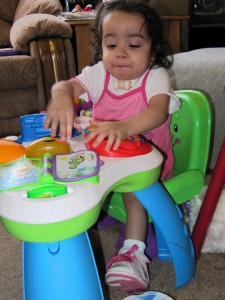
I took these pics of her today.  She was just sitting on one of her chairs with her toy desk, and she was just having a great time.

ER Visit and Tracheitis

So we ended up back in the ER today.

It all began last night when Hannah was sounded really junky in her trach.   On a normal day, we maybe suction her about 4 or 5 times in a 24-hour period (she is great at coughing out what is in her trachea).   Last night, I had to suction her at least 15 times within a few-hour period.  I stayed up late keeping an eye on her, and around 2 am she had woken up.  At around 3:30 am, I finally had to wake Daddy up to take over because I was just beyond exhausted.

After unsuccessfully trying to get her back to sleep, at 4 am he ended up taking her downstairs to the family room to just let her relax on him.  She napped for about 45 minutes more, but she still was incredibly junky and needed a lot of suctioning.

Our favorite nurse was with us today.  She came around 9 am.  Daddy had found a free place to take the kids (Spring Preserve for those locals), so they had taken off.  I was staying home with Hannah and our nurse because I had some studying to do.   Our nurse finally got Hannah to sleep around 10 am.    She slept quite peacefully, and we both commented on the lack of suctioning that we had to do this time.

Around 11:45 am, Hannah woke herself up with a harsh junky cough attack, and it required a lot of suctioning to get the gook out of her lungs.  I mean, a lot.  We both noticed that Hannah was having difficulty catching her breath after she was cleared out, and so I had placed a call to our pediatrician.  She was out of the office today, and the earliest we could see her resident was 3:30 pm.

Hannah was starting to have more respiratory distress, so I made the decision to head straight to the ER (our nurse agreed).   Like the three previous times we had been there, we were taken immediately into triage and given a room.

My biggest fear was that her pneumonia had come back.  After all, she is most susceptible to getting pneumonia again within 6 months of a previous bout, and we were only a month or so out of the hospital.

They did chest xrays, blood work (the only abnormality was her WBCs which were 18,800 which means infection), and they took a urine sample and trach culture.  The only results not available were the trach culture, which is going to take a few days.  They also had given her Tylenol because her fever hit 102.9 from 101.1 just an hour earlier in triage.

The good news is it is not pneumonia!  Her lungs looked good.  It is likely tracheitis (infection of the trachea), which kids with trachs are apparently more susceptible to.  The doctor (who recognized us, as she was the same ER doc when Hannah had her cellulitis) decided to give her about two hours worth of IV fluids and IV Rocephin before discharging us.   They gave us a prescription of augmentin b.i.d. for the infection.  This is an antibiotic that covers a lot of different bugs, so hopefully when we get the culture and sensitivities back from her trach sample, it will be covered with the augmentin.

I was so nervous that Hannah would have to be admitted again.  We had never made it to the ER discharge office since we had been to Vegas.  So when she said “No admittance this time,” my heart jumped for joy!

It is going to be another long night, as Hannah still is really junky as she sleeps.  It is about midnight now, and she has had to be suctioned almost 10 times in a 3-hour period.  My hope is to stay awake until around 4 am again and then Daddy is going to take over (he went to be early tonight).  I don’t feel comfortable with both of us sleeping with her being this congested.

What I would give for night nursing tonight….  but that is another story for another day…

Creating Hope Act 2010 Bill Would Extend Priority Review Voucher System To Rare Pediatric Diseases

** By Chris Hempel

Great news for the pediatric rare disease community came out late last week — rare disease advocates please get this out on your blogs!

Senators Sam Brownback (R-KS), Sherrod Brown (D-OH), and Al Franken (D-MN) are supporting the bipartisan bill S. 3697, the “Creating Hope Act of 2010.” Nancy Goodman, Executive Director of Kids v Cancer, is the person leading the charge on S. 3697 and a priority review voucher system for pediatric rare diseases.

In 2009, Nancy lost her son Jacob to a rare pediatric cancer called medulloblastoma. She is an inspiration to all in the rare disease community!

The Creating Hope Act of 2010 builds upon the Food and Drug Administration Amendments Act of 2007, often called the “treat and trade” program, which established a priority review voucher program for drugs or biologics targeting neglected tropical diseases. At the time this bill was passed, rare childhood diseases were excluded.

he Creating Hope Act of 2010 will encourage the creation of new drugs for underserved children like Addi and Cassi who suffer from serious and life threatening medical conditions by providing a priority review voucher (PRV) as an incentive to pharmaceutical companies who develop drugs for rare pediatric diseases like Niemann Pick Type C.

This is exactly the type of novel incentive system I have been asking for that could fast track cyclodextrin research. For example, with a PRV system in place, I could get a company like Johnson and Johnson to actually take on Niemann Pick Type C disease research and help me make a cyclodextrin drug for Niemann Pick Type C kids.  In turn, Johnson and Johnson could receive a priority review voucher that gives them priority FDA review of another application that would otherwise be reviewed under FDA’s standard review clock.

This priority review voucher could be used for a blockbuster drug that a company would want want to bring to market and receiving priority review could mean millions of dollars to a Pharma or biotech company.  This is why they would be willing to invest in Niemann Pick Type C research and cyclodextrin and help our small community bring a potentially life saving compound to market for kids like Addi and Cassi.

Since I already have an orphan drug application filed and approved with the FDA, having a priority review voucher system in place potentially makes Niemann Pick Type C an attract investment risk by Pharmas or BioTechs.

Priority reviews vouchers for pediatric rare diseases are a  win-win for everyone!  We need to rally the rare disease community to fight for the passing of S. 3697, Creating Hope Act 2010 bill.

Below are some key provisions of the S. 3697, Creating Hope Act 2010 bill:

  • Extension to pediatric rare diseases: This legislation includes rare pediatric disease within the scope of the program. This category encompasses any disease that is “rare” within the meaning of the Orphan Drug Act (affects less than 200,000 people, or the cost of development would exceed revenue) is recognized in the medical community as affecting a pediatric population and is a new drug that has not received FDA approval for an adult indication
  • Closing a loophole: This legislation would prevent companies from receiving a voucher for tropical disease products that they already market in other countries. This change will ensure that the program rewards only innovative treatments
  • Unlimited transferability of vouchers: A voucher may now be transferred unlimited times provided that the transferee, in each instance of transfer, notifies the FDA of the change in ownership. This change enables drug companies to maximize the value of the voucher in the marketplace
  • Optional upfront priority review designation process: Under the current law, sponsors do not know whether their new drug application will qualify for a voucher until the time of FDA approval. The proposed legislation permits sponsors of both tropical disease drugs and rare pediatric disease drugs to seek a designation that the new drug would qualify for a voucher, should it be approved, even before they submit their new drug application.
  • Adds Chagas disease to the list of neglected tropical diseases: Chagas disease is responsible for more deaths in Central and South America than every other parasite-borne disease, including malaria. Yet, despite its profound impact, research and development of new treatments is severely underfunded. The addition of Chagas to the list of eligible diseases fulfills the intent of the original authors.
  • Reporting and marketing requirements: The Creating Hope Act requires that the sponsor submit a statement of good faith intent to market the eligible drug, as well as a report describing the demand and distribution of the ultimate product.

Article Source

Getting into a rhythm…(yeah, right!)

Sure, it sounds good, doesn’t it?   Maybe if I say it enough, “we are getting into a rhythm,” that maybe we will eventually get there…

Hannah is doing really well.  I would say she is about 75% back to where she was pre-hospitalization.   Well, if you separate the desire and ability to play with her toys, she is at about 95%!  Girl LOVES her toys.

Now that we are weaning down the Keppra (finally weaned off her midday dose), we are noticing more choreathetoid movements, especially at night.  We are going to keep an eye on it for the next few days, and if it still gets worse at night, then I’m going to call her neuro and discuss it with her.  We have 3 more weeks before we are off the Keppra, and perhaps this “third line of defense” drug is actually doing a lot more work on her movements than we thought.

Getting Hannah into the Katie Beckett Program so we can get on Medicaid has been a nightmare.  I dropped off the forms about 5 weeks ago.  First, they screwed up by putting the application under MY name and MY social security number.  Then, they sent it to the wrong office and under a different program that Hannah does not qualify for.   Also, all the additional paperwork that we had walked into the “wrong office” that they accepted had disappeared.  A few days ago, I got a call from one of the supervisors who is going to “hand walk” it to the right office and department and put it under Hannah’s info.    We’ll see how that works out.

We are also changing our nursing schedule.   In an effort to become more of a family unit, we are making it so there is less time a nurse is here when the kids are here.   We will have nursing during the day while the kids are in school and after they get home from school so we can have time for homework and playdates, but we will have dinner alone and all together.   So instead of Monday thru Sunday, 12 pm to 8 pm, we are going to go to the following schedule:

  • Monday thru Wednesday, 8 am to 6 pm
  • Thursday, 12 pm to 8 pm (Hannah has her Cerezyme every other Thursday morning)
  • Friday, 8 am to 8 pm
  • Saturday, 3 pm to 9 pm
  • Sunday, no nurse

As for us?  House in Texas still is on the market, Daddy is still unemployed, finances are stressful, counting the days until school starts because the kids are bored and at each other’s throats…. but we are making it through!