Hannah's Bloggy Giveaway

Busy week ahead

May 31, 2009 by Mommy  
Filed under Docs, Appts, and Procedures

After glancing at my calendar for this week, I realized we have a LOT going on.

Monday – Meet with Dr. Eng, Hannah’s genetics doctor, before her Cerezyme treatment

Tuesday - Ethan and Abigail’s every-6-months dental checkup

Wednesday
– Pam, physical therapy at TCH

Thursday
– 1]  Pat, occupational therapy evaluation at TCH, 2] Jenny, developmental therapy from ECI, and 3] Ethan’s last day of school

Friday
– 1] Michelle, occupational therapy from ECI, and 2] Abigail’s last day of school

My to-do list is overwhelming, however.  Thank goodness I don’t have any early scheduled appointments on Tuesday so I will be able to tackle some of this!

Even sleeping, she is just adorable!

May 31, 2009 by Mommy  
Filed under Pics and Videos, Random Thoughts

Hannah has been sleeping in her crib for about 6 weeks or so now.  Between my video monitor and our movement sensor, I feel quite comfortable having her in there now.  She was just getting way too big to sleep in her pack’n'play overnight.  She would roll around, and she is longer than the width of the pack’n'play now!  I know, I know — it is better for her anyway.  Much more comfortable.

Last night, I was watching my monitor of her, and she just looked so adorable.  So, at midnight, I took this picture with my phone.  

Hannah’s Surestep Orthotics fitting today!

May 30, 2009 by Mommy  
Filed under Life with GD23


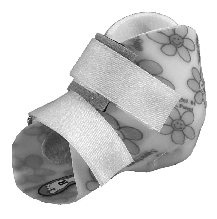
I took Hannah to her orthotics fitting this afternoon.  Now that I am aware of her constantly rolling her ankles because of weakness (hypotonia), I can see why it will be a good idea for her.  The procedure itself was incredibly easy.  The orthotics specialist just took about 9 measurements on each foot and that was it.  Hannah did great, and she only squirmed during the last measurement!

We still don’t know if the insurance company will cover it, but they will let us know when they process the paperwork.  Keeping my fingers crossed there. 

samples2006He gave me a choice of patterns, and I chose the “blossom” pattern.  My reasoning?  I thought Abigail would like it the best out of all of them.  You know, my girly girl.  Cute little pink and purple flowers with butterflies. 

 The orthotics specialist told us that he would probably give me a call in about 3 weeks to bring Hannah in to test the fit.  Also, he made the comment that it is more difficult to find shoes that will fit over the orthotic braces at her age, but you know me, I will take on that challenge.

It is kind of bittersweet though.  Until now, Hannah hasn’t needed any “outward” assistive devices.  To everyone on the street, she just looks like a normal happy baby.   This will be the first assistive device that she will have to have.  I know, it is stupid because a lot of kids have these, and it could be SO much worse.  

But it is nice being able to be in denial every once in a while…

Creating a plan of attack with the National Gaucher Foundation

May 29, 2009 by Mommy  
Filed under Project Hannah

Unfortunately there is a lot that I have been doing for the past few months that I can’t blog about.  But I have been talking to researchers all over the country, different lysosomal storage disease organizations, as well as trying to reach out to the media.  I really only post when it is something that is “nonpolitical” or published. 

Today, I had a wonderful conversation with the head of the National Gaucher Foundation for about 45 minutes.  They have been so incredibly supportive of our fight against GD23, and they have opened their arms wide open to our families.  For the past 10 years or so, there was an agreement that the Children’s Gaucher Research Fund would fund and support GD23 families, and the NGF would fund and support GD1 families.  So, to take us in with such passion and care after a decade, it has just been fantastic.

She and I are going to work together to come up with a sensible plan to get a real formalized research plan and structure together.  She has some ideas that she is going to work on during the next week, and I have a lot of ideas and contacts to bring into the mix.   I really think she and I will work well together.  She supports my passion and drive, yet I feel comfortable enough with her because she is not afraid to be honest with me about how things “work” and keeps my feelings in check as to not to get my hopes up. 

Our concept is instead of having a few researchers here and there doing their own thing, we are going to attempt to create a huge umbrella with all the Gaucher organizations and other related diseases working together,  get a common point where all the research information is kept updated, and work on finding research that could make a difference for kids like Hannah who are here today, still fighting. 

Bottom line, our goal is to get work towards finding a treatment for our kids.

With the power and expertise of the National Gaucher Foundation behind us, I really believe we have the chance to get some real research done.  Keep your fingers crossed…

Baby J, you will never be forgotten…

May 27, 2009 by Mommy  
Filed under Coping, GD23 Families

Baby J.  He wasn’t even 7 months old.  I emailed with his mom a few weeks ago shortly after he was diagnosed.  Now he is gone.   He had Gaucher’s type 2.  My heart is breaking for his parents, as it just happened so quickly.

I’ve been sitting here with Hannah leaning against me, watching the Wiggles, thanking whoever would listen that she is still here with me.  Thirty minutes, I have been trying to write this post, and in between my tears for J’s family and for Hannah, I just have a hard time putting my feelings into words. 

Being in the rare disease community, we have seen other children lose their battles and their lives to these diseases.  But this is the first time that I knew that Joseph was alive and fighting, and now he is gone.   Does that make any sense?  I don’t make any sense.

This has completely shaken me, literally.   I’m not naive…I see the progression of this disease in Hannah, and now with J…argh!   I don’t even know what to say.   I can’t seem to think of anything else right now.  I don’t know what to do.

Happy 10-month birthday, Hannah!

May 25, 2009 by Mommy  
Filed under Milestones


Happy birthday to you,
Happy birthday my Little Miss Hannah,
Happy birthday to you!

It is so exciting to finally think about celebrating Hannah’s first birthday.  This was a luxury that we hadn’t allowed ourselves to think about up until just this past couple of weeks.  Honestly, we weren’t sure if she would be here for her first birthday. 

But we are just two months away, and now it is time to start planning your party!!!!

Sly Syndrome: Delivering Medicine To Fight Rare Genetic Disorder

May 25, 2009 by Mommy  
Filed under Gaucher's - Research

http://www.sciencedaily.com/releases/2007/07/070726085925.htm

ScienceDaily (July 27, 2007) — The scientist who discovered “Sly Syndrome” nearly four decades ago and a team of colleagues at Saint Louis University are a step closer to finding an approach to treat the rare genetic disease. Sly Syndrome causes bone defects, mental retardation, vision and hearing problems, heart disease and premature death.

They found that a potentially life-saving enzyme can be induced to cross the blood-brain barrier, a structure which protects the brain from foreign substances, if it is given with the hormone epinephrine.

Ever since William S. Sly, M.D., chairman of the department of biochemistry and molecular biology at Saint Louis University, discovered the rare genetic disease in 1969, he and his colleagues have conducted research to learn more about how to treat it.

He says their recent findings have significance beyond treating the extremely rare disease that bears his name.

“There are at most 100 living cases of Sly Syndrome. Nonetheless, this disease is a model for all the diseases in this group, some of which are much more common,” Sly says.

“Lysosomal storage diseases affect 1 in 7,000 live births, and 90 percent of those with the diseases have brain involvement. What we find with Sly Syndrome has some importance for all those diseases as well. It is potentially a big finding and an important first step.”

The discovery potentially points to a new way to get big molecules, such as certain medications, across the blood-brain barrier. It is reported in the Proceedings of the National Academy of Sciences online early edition the week of July 16.

SLU researchers found that the right amount of epinephrine probably works by stimulating transport by vesicles — blister-like wrappers that carry substances across the blood-brain barrier – so that the enzyme missing in patients who have Sly Syndrome can get into the brain.

Those who have Sly Syndrome lack the enzyme called beta-glucuronidase. Without this enzyme, protein-sugar molecules accumulate in the brain and other organs in the body. By replacing the missing enzyme, doctors believe they can treat the genetic disease.

The problem, though, was slipping the enzyme past the blood-brain barrier to where it needs to do its work.

“This is a disease that is simply made for testing drug delivery vehicles. If you can get the enzyme into the brain, the vehicle that delivered it could work to deliver other chemicals, too,” says William A. Banks, M.D., professor of geriatrics and pharmacological and physiological sciences at Saint Louis University, and a leading researcher on the blood-brain barrier.

Sly Syndrome, which occurs in fewer than one in 100,000 births, is a progressive disorder that ranges in severity from mild to deadly. It is among a group of genetic diseases call mucopolysaccharidoses.

“Some children who have this group of diseases are doomed to an early death because they don’t make a certain enzyme,” Banks says.

Enzyme replacement therapy — or putting the missing enzyme into the bodies of those who have Sly Syndrome — holds promise in treating the physical problems of the disease.

“In the case of Sly Syndrome, the missing enzyme is more than 1,000 larger than a sugar molecule and so huge it can’t get across the blood-brain barrier, which prevents it from reaching the brain.”

Scientists used a mouse model to figure out how to get the enzyme into the brain. They knew that injections of the missing enzyme into the brains of baby mice reached their target, but similar injections into mature mice did not. As the mice grew older, the transporter that brought the enzyme past the protective blood-brain barrier was lost.

“We found that the right amount of epinephrine allowed the enzyme to pass into the brain of older mice, which means we reinduced the way to get the enzyme where it is needed,” Banks says.

Epinephrine is a drug that treats cardiac arrest and is given to open the airways of asthma patients who have difficulty breathing. Discovering epinephrine as the transportation key to unlock the blood-brain barrier for the missing enzyme was “a shot in the dark,” Banks says.

 ”High doses of epinephrine can destroy the blood brain barrier and let everything into the brain, which is toxic,” Banks says. “We tested three things. One didn’t work at all. One worked partially and epinephrine worked incredibly well.”

The finding changes how scientists look at getting medications through the blood-brain barrier, he says, and could have implications for treating other diseases such as Alzheimer’s disease and obesity.

Instead of viewing the blood-brain barrier as an obstacle to fight, researchers should consider it something to finesse, using its special features to help in drug delivery, Banks adds.

“The field has approached the problem as if you have a Volkswagen that can get across the street and you put your cargo on it so the cargo can get there too. We’ve found that trying to transport the cargo changes the Volkswagen and the Volkswagen can no longer get across.”

The research was funded by the National Institutes of Health, The Sanfilippo Syndrome Medical Research Foundation and VA Merit Review.