Busy 10 days…

We have a lot of stuff going on over the next week or so.

Thursday:  Sleep-deprived EEG, Vision therapy
Friday: Hydrotherapy
Monday: Cerezyme treatment
Wednesday: PT, OT, BAER study
Thurday: Abdominal ultrasound, ENT appt, Speech therapy, Vision therapy
Friday: Hydrotherapy, Developmental therapy

I think out of all the days, next Thursday is going to be the most nerve-wracking.  We have the abdominal ultrasound at 7:30 am downtown where they are going to measure Hannah’s liver and spleen to see where we are at one year after starting the Cerezyme treatments.

We also meet with Dr. Roy, Hannah’s ENT, right after the ultrasound at TCH.    I’m anxious about this appointment, because I know the “trach” conversation is going to be brought up again.  Thankfully, Hannah has not had any more gagging/breathing episodes since we took away her goldfish and cheerios.

But I told myself, when the day comes that Dr. Roy, Dr. B (Hannah’s pediatrician), and Dr. Goker-Alpan (NIH) all agree that it is time for Hannah to get a trach, then I will do it.   In my heart, I just don’t believe we are there just yet, but admittedly I do see it coming in the future if Hannah’s sensitivities increase more.

The Scientist Magazine: A Rare Chance

Over the course of 5 days last summer, an army of researchers and clinicians examined, poked, and prodded 1-year-old Hannah Ostrea at the National Institutes of Health (NIH). Experts in neurology, rehabilitation medicine, physical therapy, speech pathology, and anesthesiology gave the little girl an EEG, a test of her heart’s electrical activity (EKG), an MRI, a CT scan, X-rays, and a throat exam (laryngoscopy). All this testing was meant not only to help Hannah but in the hope that her rare disease could reveal something about another condition that affects 1 million Americans: Parkinson’s.

Hannah has Gaucher’s disease, and within hours of her birth, it was obvious something was wrong. Looking past her thick head of dark hair, and the fact that she could down an entire bottle of formula in 5 minutes, clinicians quickly saw that her spleen was massive, and her platelet counts were rock bottom. Her liver was expanding—in a few months it looked like she had a volleyball in her stomach. These are the classic signs of Gaucher’s, a rare, recessive genetic disorder in which the body does not produce enough of a lysosomal enzyme that breaks down the fatty substance glucocerebroside, causing it to glob up in cells of the liver, spleen, and other organs—including, sometimes, the brain.

But researchers have never seen the combination of mutations Hannah carries, so doctors couldn’t determine if she had the Type 2 or Type 3 form. Children with Type 2 typically die before their third birthdays, while those with Type 3 can live much longer. “They [wouldn’t] give us a prognosis,” Hannah’s mom, Carrie Ostrea, says. “They came out and said that to us. Which is fine by me.”Hannah has many classic Gaucher’s symptoms, such as developmental delays, and the inability to easily shift her eyes from side to side or up and down. But she also has some puzzling symptoms. For one, she only blinks once every 30 minutes or so—“you’ll have a staring contest with her,” Ostrea laughs. This is not a symptom of Gaucher’s disease, but it is a symptom of Parkinson’s.

Indeed, in recent years, researchers have been noting more and more crossover between the two diseases, and the hope is that insights into one will reveal secrets of the other.

In an October issue of the New England Journal of Medicine, Ellen Sidransky at the NIH and her colleagues found that Parkinson’s patients were five times more likely to carry a mutation in the gene associated with Gaucher’s disease. Furthermore, Parkinson’s patients with the mutation in the Gaucher’s gene tended to develop Parkinson’s earlier, and were more likely to have family members with Parkinson’s (N Engl J Med, 361:1651–61, 2009). It’s unknown how many people have signs of both diseases, Sidransky notes, but it’s “clearly dozens and dozens.”

Still, Parkinson’s and Gaucher’s are more different than they are alike. One comes from a deficiency of the lysosomal enzyme that breaks down glucocerebroside, the other likely from a deficiency of dopamine, and it’s largely unclear why the two diseases are linked, says Sidransky. Perhaps the lysosome plays a role in Parkinson’s; the protein misfolding that underlies Parkinson’s may be aggravated by mutations in the Gaucher’s gene.

Gaucher’s itself is an interesting model for trying to understand single-gene diseases, Sidransky adds. She and her colleagues like to invite patients with rare presentations of a disease to the NIH to study them and hopefully learn something about an entirely different condition. “I’ve always been convinced that focusing on one thing and becoming an expert helps you see connections” between that one question you’re investigating and other unanswered—perhaps even more significant—questions.

The NIH visits can be long, but Hannah held up fairly well, her mother says. She didn’t like waking up from the EEG and being tied down, and didn’t like the heart ultrasound, but the neuro-ophthalmologist got her to laugh hysterically by turning his video camera around so she could look at herself. “She just thought that was the funniest thing in the world,” Ostrea says.

Nursing Home Visit – Third Time is the Charm!

We did it!  We accomplished our last step in getting Hannah Medicaid and on the Medically Dependent Children’s Program!!!  We satisfied our nursing home stay requirement.

We left Friday after the kids came home from school.  We made sure Hannah had a good nap right before, a full tummy, and was just as happy as we could make her.  We figured we would leave the day before just to make sure we would make it and give us the chance to spend the night along the way if we needed it.  Fortunately, we made it all the way with only three Hannah tantrum episodes where we had to get her out of the car and calm her down.

We had a 11 am check-in time, and we decided we would check in around 10 am.   It figures that our car battery died AGAIN, and we were scrambling to get AAA there starting at 9:00 am (the nursing home is 15 minutes from the hotel).  We were ALMOST ready to call a cab at 10:20 when AAA finally showed up!  We made it to the nursing home with 8 minutes to spare.

It wasn’t as bad as I expected, but it definitely was a nursing home environment with many elderly people just sitting around, some in wheelchairs, and some just talking to themselves in the hallway.  We checked in, and Hannah crashed on the bed in our room.  So Daddy took Ethan and Abigail to Chuck-E-Cheese for a couple of hours.

Fortunately, we were able to leave the nursing home for a break because we just needed to check in every 2 hours because they want to know the “status” of how Hannah was doing.   When we finally got back at 8:45 pm for the night, Hannah and I locked our room door (as our nurse instructed us to do), and made ourselves as comfortable as possible.

It was a freezing room, and the train tracks were right outside our window.   That wasn’t the worst part.  At 5:30 am, I heard a banging on our room door.  I thought it was one of the nurses, but it was an elderly man in a wheelchair banging on my door.  I saw him, and I quickly closed to door, remembering in the back of my mind that the nurses said not to open the door (they have keys to our room).  Freaked me out a bit, but oh well.

I didn’t get much sleep anyway.  I fell asleep around midnight, woke up at 1:30 am to change Hannah (she slept in the queen bed next to me).  Then, Hannah woke up at 4 am “just because.”   Checkout was at 6:30 am, and sure enough, Daddy, Ethan, and Abigail picked us up right on time!  I couldn’t get out of there any faster.

We went back to the hotel for a quick breakfast, and then we headed out on the road.  It was a rough time getting home, as Hannah had about 8 or 9 episodes on the way home, including four times having to stop on the side of the highway to take her out of the car to get her to calm down.  She was exhausted, hungry, and did not want to be in her carseat.  We stopped for lunch about halfway through, and she fell asleep in the restaurant.  Unfortunately, that “nap” wasn’t enough, and she woke up as we put her back in the car.  We ended up sitting in the parking lot for about 20 minutes just to get her calmed down enough where we could put her back in the carseat.   We even had to stop twice about 2 miles from our house and a block from our house.

But we made it.  It is done.  Our 10-month process of trying to get Hannah onto this program is done.  Now I just need to get our case manager to finalize everything, and then we can start looking into getting some help!  Hopefully that won’t take too long, but I have already been warned by another mom that I need to keep on him to get it done.

But we made it.  Nursing home visit — DONE!

Milestone Cerezyme treatment day

Cerezyme treatment #26

Cerezyme treatment #26, a milestone

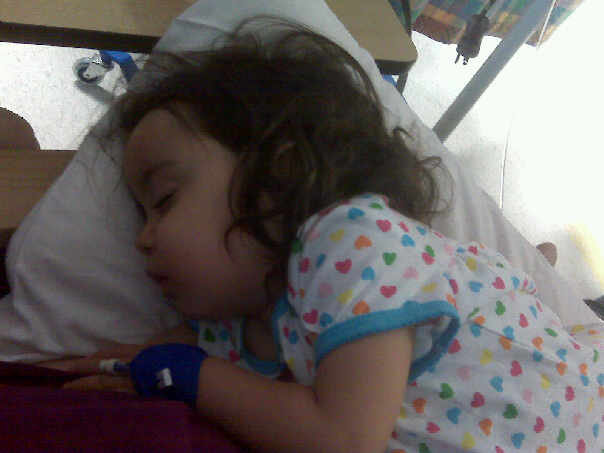
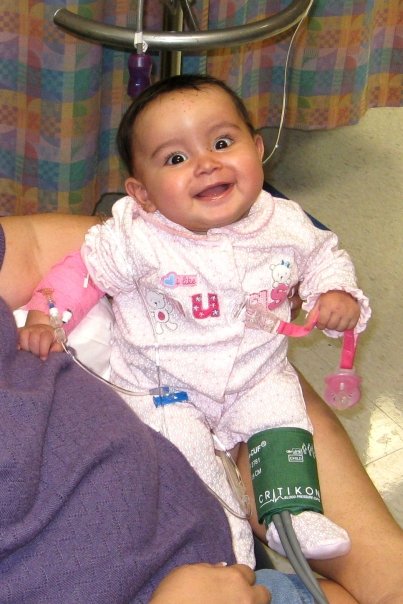
Today was Hannah’s 26th Cerezyme treatment.  Every two weeks for the past year, we have made the drive down to Texas Children’s Hospital’s Infusion Center.   For 2-1/2 hours, Hannah is cuddled up against me (usually asleep) while she gets her life-prolonging enzyme replacement therapy treatment via an IV in her hand.

We have been lucky that she has not needed a surgical port placed yet.  We, along with her doctors, have all agreed that a one-minute cry during the input of an IV far outweighs the risks of having to deal with an surgically placed infusion port inside her chest.  The nurses at TCH have been able to master her IV placement, and it literally takes less than a minute to get it done.  Even Dr. Schiffmann, her Gaucher specialist, was incredibly impressed by this feat.

Cerezyme treatment #1, February 9, 2009

In my heart, I truly believe the Cerezyme treatments have kept Hannah alive longer than if she had not had the treatment.  I look back at how large her spleen and liver where when we started at 6 months old, and she would have probably suffocated because they were already shrinking her lung capacity by their size.

I know they say that Cerezyme does not cross the blood-brain barrier.   But making her more comfortable by dealing with the other physical symptoms of type 1 Gaucher’s (bone pain, spleen and liver enlargement, etc) has made Hannah much more comfortable and happy.

Hannah is not in any pain.  She does not live in pain.  For that I am incredibly thankful.

One year of treatments down.  A lifetime to go.

Failed attempt #2

We didn’t make it again to the nursing home, but this time it had nothing to do with Hannah.

Abigail seems to have caught a 24-hour stomach bug of some sort and had been vomiting every-hour-on-the-hour for almost 12 hours straight!    She seems a bit better today, but there just was no way that we were going to make a drive dealing with both her and Hannah.  Abigail was so upset that we had to postpone our “vacation” (even though we told her it wasn’t a fun vacation).

The nursing home coordinator is also not so pleased.  We rescheduled for next weekend, but I got the impression from her that “3 strikes and you are out.”

Great, no pressure there!

Nursing Home Visit – attempt #2

After a horrible attempt for a road trip last month to try and get our nursing home overnight stay requirement filled so that Hannah can be approved for the medically depedent children’s program (and medicaid), we are going to try again this weekend.

Last time, we only made it about 45 miles of a 200 mile drive before we had to return home.  She had 3 beginnings of a hypervenilation episode (as a result of a tantrum of not liking behind confined) and one actual hyperventilation episode, all requiring us to pull over for about 10 minutes, get her out of the car, give her some fresh air and cuddles, and then move on.  Also last time, she was teething horribly and completely congested, so in hindsight, it probably was not a good move to go that weekend.

We are going to try again this weekend.  We have to check in by 11 am on Saturday, so we are actually going to leave when the kids get home on Friday afternoon.  This way, we can drive as far as we can on Friday and spend the night in whatever city we can get to.  Hopefully we can make it the entire way Friday (it would normally be a 4-hour drive, but not with our situation).  But this gives us a cushion just in case we have to stop and give her a break.

I will admit that I am incredibly nervous about this trip.  The first 40 miles is in more of a rural area, so if for some reason we needed 911, it would not be that quick.  We will definitely be taking our oxygen with us, actually a couple of tanks “just in case.”   We have the DVDs ready to go, but even those only taking her mind off things for a period of time.

I don’t know what it is about her and driving.   She tends to do it when she is more on the tired side (not nap tired, but just up for a while), and when she is not feeling well.  We were able to make it to Katy last weekend (45-minute drive) without a problem, but on the way home, she had another episode, and we had to pull off the freeway and give her fresh air.

I hope, hope, hope this works.  I don’t know what we will do if it doesn’t.  We thought about flying closer to the nursing home, but there would still be an hour+ drive from the airport, but then we have to pay for airline tickets.  We thought about renting a small RV (which the kids would love), but even that is a few hundred dollars.

Just keeping my fingers crossed…